
Best Watercolor Paint Brands For Beginner Or Professionals
Artists call their available selection of paints, their "palette". Getting started with the correct palette is really important. As you use your paints you get into the habit of mixing them in particular ways. These habits become a part of your style. A part of you as an artist. If you start with the best possible selection, your choices will always be maximized.
There is no perfect palette, and what works for me may not work so well for someone else. Therefore what I am offering is a starting point. Hopefully you will also find it to be all you need.
I am going to discuss the sedimentary properties of colors, which is what makes watercolors look like watercolors, and what makes them so beautiful.
I will also discuss a palette for mixing any color at all.
Even if you are an experienced watercolorist, you will probably get some new ideas.
MATERIALS LIST
Hover Or Click
A Color For Information
Burnt Sienna
A sedimentary color; sediments quickly offering a mottled or shimmery look to the final (wash)
+ close +Viridian
A sedimentary color; sediments quickly offering a mottled or shimmery look to the final (wash)
+ close +Pthalocyanine Blue
A "warm" (greenish) blue.
A non sedimentary color settles out smoothly yielding a uniform finish (wash)
+ close +Pyrrol Red
A "warm" (orangish) red.
A non sedimentary color settles out smoothly yielding a uniform finish (wash)
+ close +Arylide Yellow FGL
A "warm" (orangish) yellow.
A non sedimentary color settles out smoothly yielding a uniform finish (wash)
There is not an industry standard name for this color. I am offering DaVincis Brand name.
+ close +Yellow Ocher
A sedimentary color.
sediments quickly offering a mottled or shimmery look to the final (wash)
+ close +Cerulean Blue
A sedimentary color.
Sediments quickly offering a mottled or shimmery look to the final (wash)
+ close +Ultramarine Blue
A cool (purplish) blue.
A non sedimentary color settles out smoothly, theoretically yielding a uniform final (wash).
Actually Ultramarine Blue "flocculates" (gathers in clumps) so we only get a fairly smooth (wash)
Sadly, it's the only purplish blue thats light-fast and available to artists.
+ close +Alizarin Crimson
( Quinacridone )
A cool (purplish) red.
A non sedimentary color settles out smoothly yielding a uniform finish (wash)
n fact, Alizarine Crimson (a very early man made pigment) lost favor when it was found non light-fast.
Today we replace it it with a better version of the same color called Quinacdridone Red.
Nevertheless, manufacturers still call it Alizerine Crimson.
+ close +A cool (greenish) yellow
A non sedimentary color settles out smoothly yielding a uniform finish (wash)
There is not an industry standard name for this color. I am offering the DaVincis Brand name.
+ close +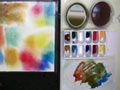 A Guide For Choosing And Buying Watercolor Paints.
 Watercolor Paper; Weight And Grades, And What They Mean To You.
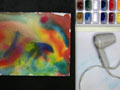 Tools For Watercolor Painting. Palette, Hair Dryer, Etc.
 Everything You Need To Know About Watercolor Brushes
 How to Shop For A Watercolor Brush
 Watercolor Brush Care

Everything on this site is copyrighted,
Nothing may be copied or reproduced anywhere without written permission!