Watercolor Skies Lesson - Blue Realistic Skies With Birds And Light Fluffy Clouds.
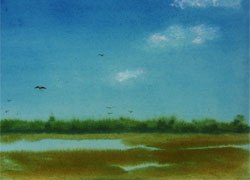 This lesson is about how to paint realistic skies with watercolor.
Landscape painters need good skies. Skies are rarely the subject of a landscape, but it is definitely the curtain at the back of the stage; a critical element in the design.
Few people realize how important sky color is to their own emotional state. Gray days are just that. Sunny days have sharp shadows. These shadows are filled with light, but obviously not sunlight Landscape shadows are suffused with sky light, and sky light is blue. Often, when a painting makes feel good we are responding to crisp, blue shadows.
Clouds are incredibly important in a landscape, or seascape. They break up the sky space. They tell us about the weather. They can be hard or soft, dark or light, and come in an infinite variety of shapes and colors.
I use this lesson as an opportunity to introduce white paint into my lessons. White comes in very modern, titanium white, and very classic, white gouache, which is a watercolor made with chalk. This lesson covers how to use gouache. More importantly, it covers how not to use gouache.
We use our painted sky to create a complete wet in wet painting of a marsh. Then, when all is dry we cover up some blemishes with birds, and we learn how to make them appear close or distant.
MATERIALS LIST
Hover Or Click
A Color For Information
Burnt Sienna
A sedimentary color; sediments quickly offering a mottled or shimmery look to the final (wash)
+ close +Viridian
A sedimentary color; sediments quickly offering a mottled or shimmery look to the final (wash)
+ close +Pthalocyanine Blue
A "warm" (greenish) blue.
A non sedimentary color settles out smoothly yielding a uniform finish (wash)
+ close +Pyrrol Red
A "warm" (orangish) red.
A non sedimentary color settles out smoothly yielding a uniform finish (wash)
+ close +Arylide Yellow FGL
A "warm" (orangish) yellow.
A non sedimentary color settles out smoothly yielding a uniform finish (wash)
There is not an industry standard name for this color. I am offering DaVincis Brand name.
+ close +Yellow Ocher
A sedimentary color.
sediments quickly offering a mottled or shimmery look to the final (wash)
+ close +Cerulean Blue
A sedimentary color.
Sediments quickly offering a mottled or shimmery look to the final (wash)
+ close +Ultramarine Blue
A cool (purplish) blue.
A non sedimentary color settles out smoothly, theoretically yielding a uniform final (wash).
Actually Ultramarine Blue "flocculates" (gathers in clumps) so we only get a fairly smooth (wash)
Sadly, it's the only purplish blue thats light-fast and available to artists.
+ close +Alizarin Crimson
( Quinacridone )
A cool (purplish) red.
A non sedimentary color settles out smoothly yielding a uniform finish (wash)
n fact, Alizarine Crimson (a very early man made pigment) lost favor when it was found non light-fast.
Today we replace it it with a better version of the same color called Quinacdridone Red.
Nevertheless, manufacturers still call it Alizerine Crimson.
+ close +A cool (greenish) yellow
A non sedimentary color settles out smoothly yielding a uniform finish (wash)
There is not an industry standard name for this color. I am offering the DaVincis Brand name.
+ close + Coloring Book
First Watercolor Lesson, Washes And Values.
 Color For Beginners - How to mix all the colors.
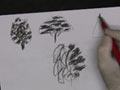 How To paint trees - The Fundamental Concepts.
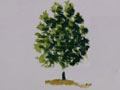 How To Paint A Tree Using Watercolor - A Beginner Lesson.
 Preparing watercolor paper for wet in wet painting
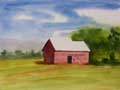 Painting A Barn - A beginner landscape lesson.
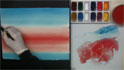 Watercolor Painting
Sunrise / Sunset
(Dawn / Dusk)
Part 1 Painting The Sky.
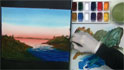 Watercolor Painting
Sunrise /:65px Sunset
(Dawn / Dusk)
Part 2 Painting The Islands.
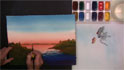 Watercolor Painting
Sunrise / Sunset
(Dawn / Dusk)
Part 3 Painting The Lighthouse
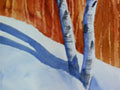 Birch Trees In The Snow. - A Watercolor Scraping Technique Lesson

Everything on this site is copyrighted,
Nothing may be copied or reproduced anywhere without written permission!