Color for beginners - How to mix all the colors ( Using just a few).
Color
Lessons For The Beginner
There are three primary colors; Red, Blue and Yellow. (or cyan, magenta and yellow). The problem with primaries is that we can not determine what a true primary is. During the lesson we see an example example of our inability to choose a specific blue as primary.
The way to get raound this problem is to have two tubes of all each primary, each one slightly of to either side the primay.
Mixing the primaries is something you just have top know, but there are only three facts. Red and blue makes purple. Red and Yellow makes orange. Yellow and blue makes green. Orange, green and purple are secondary colors. Primaries and secondary colors are bright, clean colors, such as you would use to paint flowers. As these colors darken, we call them neutrals.
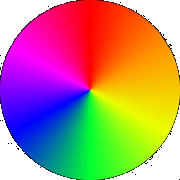 Once we have the correct 6 tubes of paint, we can mix every color of the rainbow.
We also learn that mixing "across" the wheel we can create any dark
(neutral or gray) of any color. Neutral colors include, Among many
others, brown, mustard, indigo, olive, etc.
Once we have the correct 6 tubes of paint, we can mix every color of the rainbow.
We also learn that mixing "across" the wheel we can create any dark
(neutral or gray) of any color. Neutral colors include, Among many
others, brown, mustard, indigo, olive, etc.
Now that we have all of the clean colors and all the neutrals, we can thin any one of them with water to produce a "tint". Tints are very light colors like pink and gray.
Color is one of my five elements of composition. They are, line, shape, value, color and texture.
This lesson is not only useful for painting with watercolors. but also with any art medium such as acrylics.
MATERIALS LIST
Hover Or Click
A Color For Information
Burnt Sienna
A sedimentary color; sediments quickly offering a mottled or shimmery look to the final (wash)
+ close +Viridian
A sedimentary color; sediments quickly offering a mottled or shimmery look to the final (wash)
+ close +Pthalocyanine Blue
A "warm" (greenish) blue.
A non sedimentary color settles out smoothly yielding a uniform finish (wash)
+ close +Pyrrol Red
A "warm" (orangish) red.
A non sedimentary color settles out smoothly yielding a uniform finish (wash)
+ close +Arylide Yellow FGL
A "warm" (orangish) yellow.
A non sedimentary color settles out smoothly yielding a uniform finish (wash)
There is not an industry standard name for this color. I am offering DaVincis Brand name.
+ close +Yellow Ocher
A sedimentary color.
sediments quickly offering a mottled or shimmery look to the final (wash)
+ close +Cerulean Blue
A sedimentary color.
Sediments quickly offering a mottled or shimmery look to the final (wash)
+ close +Ultramarine Blue
A cool (purplish) blue.
A non sedimentary color settles out smoothly, theoretically yielding a uniform final (wash).
Actually Ultramarine Blue "flocculates" (gathers in clumps) so we only get a fairly smooth (wash)
Sadly, it's the only purplish blue thats light-fast and available to artists.
+ close +Alizarin Crimson
( Quinacridone )
A cool (purplish) red.
A non sedimentary color settles out smoothly yielding a uniform finish (wash)
n fact, Alizarine Crimson (a very early man made pigment) lost favor when it was found non light-fast.
Today we replace it it with a better version of the same color called Quinacdridone Red.
Nevertheless, manufacturers still call it Alizerine Crimson.
+ close +A cool (greenish) yellow
A non sedimentary color settles out smoothly yielding a uniform finish (wash)
There is not an industry standard name for this color. I am offering the DaVincis Brand name.
+ close + Coloring Book
First Watercolor Lesson, Washes And Values.
 Color For Beginners - How to mix all the colors.
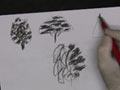 How To paint trees - The Fundamental Concepts.
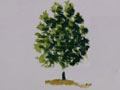 How To Paint A Tree Using Watercolor - A Beginner Lesson.
 Preparing watercolor paper for wet in wet painting
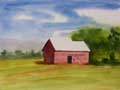 Painting A Barn - A beginner landscape lesson.
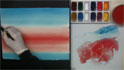 Watercolor Painting
Sunrise / Sunset
(Dawn / Dusk)
Part 1 Painting The Sky.
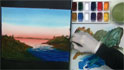 Watercolor Painting
Sunrise /:65px Sunset
(Dawn / Dusk)
Part 2 Painting The Islands.
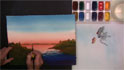 Watercolor Painting
Sunrise / Sunset
(Dawn / Dusk)
Part 3 Painting The Lighthouse
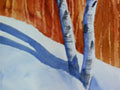 Birch Trees In The Snow. - A Watercolor Scraping Technique Lesson

Everything on this site is copyrighted,
Nothing may be copied or reproduced anywhere without written permission!